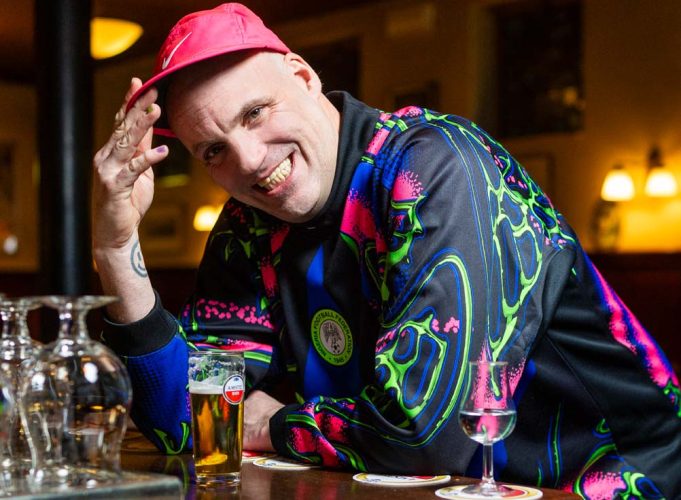
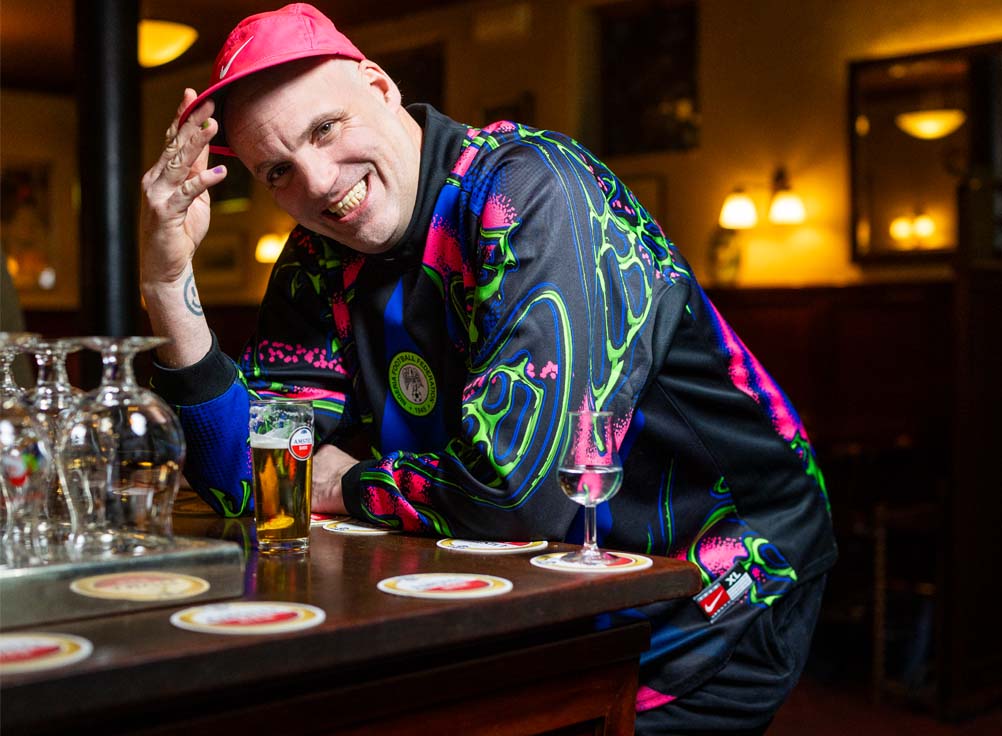
Prominent Utrechters talking about their favourite spot in the city. This month: DJ and producer Freek Fabricius tells us about Café Van Wegen in Lange Koestraat, which is around 140 years old.
So… Café Van Wegen?
‘It’s like landing in the 1950s in a time machine. The interior from that period, the old-fashioned publican behind the bar. But there’s no music either – it’s about conversation in Van Wegen, which is why I love going there. Not as often as I used to when I had my DJ cooperative 030303 and much of my time organising parties. Then we liked coming here for the peace and quiet. Now we’re getting older, we’re doing fewer parties, but I still DJ every month in De Helling, De Nar and KABUL à GoGo. And I do a lot of studio work for my record label in our studio in the Hof van Cartesius, another really nice place.’
Biggest irritation?
‘I’m a very positive person, and decided years ago not to be too quick to judge. I think I was able to make this choice because I was dealt a good hand of cards in this life. I was born in the Netherlands to start with. I think it’s a real pity that all the authentic independent businesses in Utrecht are disappearing. The billiard bar De Windhoek on Laan van Nieuw-Guinea has closed its doors, for example. It was a great place to eat home-made schnitzels and now it’s being turned into a child-friendly restaurant. It’s not as bad as Amsterdam yet, with all those peanut butter shops, but the city’s steadily becoming less personal without those small businesses, which people put their heart and soul into.’
Best memory?
‘Towards the end of the pandemic, I was asked to play a set at Unmute Us. This was the events sector’s protest against the closure of nightlife, and a procession of 12 or so sound trucks drove through the city. My girlfriend (Arlette de Jong, managing director of De Helling, ed.) said: “Let’s go!” It was one big explosion of joy. We walked across Janskerkhof and the Singels, with my son on my shoulders, while thousands of Utrecht locals took to the streets to dance. They were joined by people on their balconies, passers-by and even a few police officers. It was fabulous to see everyone embracing the fact that they could be together again.’
Last show/concert you saw?
‘During the Drop Acid, No Bombs club evenings in KABUL à GoGo, there are performances by artists as well as DJs. My friend Vincent Schoutsen, who’s also at the Hof van Cartesius with Het Uitvindersgilde, did a gig. Vincent is a musical inventor and artist, and does really cool stuff. He wears a kind of music suit with a drum computer on his back, for example, making him a one-man acid band. He’s also got a fitness machine that he uses to make gabber music. We could all use a bit more of that punky attitude.’’
Last time you cried?
‘I cry at anything, but particularly at the performance by singer-songwriter Beverly Glenn-Copeland at Le Guess Who? In 1961, he was one of the first black students at the University of Montreal, and the pain he was subjected to really comes across in his music. He uses a synthesizer, and has the same kind of androgynous air as the singer in Anohni and the Johnsons (formerly: Antony and the Johnsons, ed.)
I enjoy all kinds of music, as long as I can feel the passion. That’s why I love Le Guess Who? Their programme isn’t commercial; everything comes straight from the heart, with so much love.’
Inspirational Utrechter?
‘The late Imro Hetten, Utrecht’s best-known rough sleeper, also known as the UFO pilot. Imro used to be a musician in the Italo disco and a talented Thai boxer. He sadly became an addict and ended up on the streets. But while sleeping rough, he wrote poetry for the homeless newspaper and sang songs for money. But he shot to fame when online videos of him started to appear, in which he claimed that he was a UFO pilot from Erra, a planet in the Third Valley of the Universe.
Despite his mental health problems, Imro was a highly intelligent, creative soul. I’m moved by his story, and that of the other rough sleepers in Utrecht. Instead of judging them, we should try to talk to them and help where we can.’
 Lees in het Nederlands
Over dit artikel
text:
Sarah-Mie Luyckx
images:
Juri Hiensch
Publication date:
10 March 2026
Magazine edition:
UITagenda Utrecht maart 2026