
Anyone scrolling through social media can’t help noticing that these days, stand-up comedians enjoy interacting with their audience. In the run-up to the Utrecht International Comedy Festival (UICF), UITagenda decided to take a closer look at this trend.
A typical Wednesday evening at a comedy show in Utrecht:
‘You!’ The comedian on stage points to a man in the audience. ‘When I point at you, you say ‘‘Whoop! Whoop!’’ Got it?’ The man nods. The woman on stage resumes her act: ‘So, child pornography.’ She points to the man, who gamely shouts ‘Whoop! Whoop!’ amid much hilarity.
It’s all recorded on camera so the comedian concerned has new content for her social media.
Unique moments
The increase in the number of clips being posted online featuring audience participation can’t have escaped the notice of comedy fans. Take the American comedian Matt Rife, whose encounters with audiences made him so popular that he now performs throughout the world. Or the Dutch Kor Hoebe, whose shows include countless ‘chats’ with members of the public. At the time of writing, his tour is almost sold out.
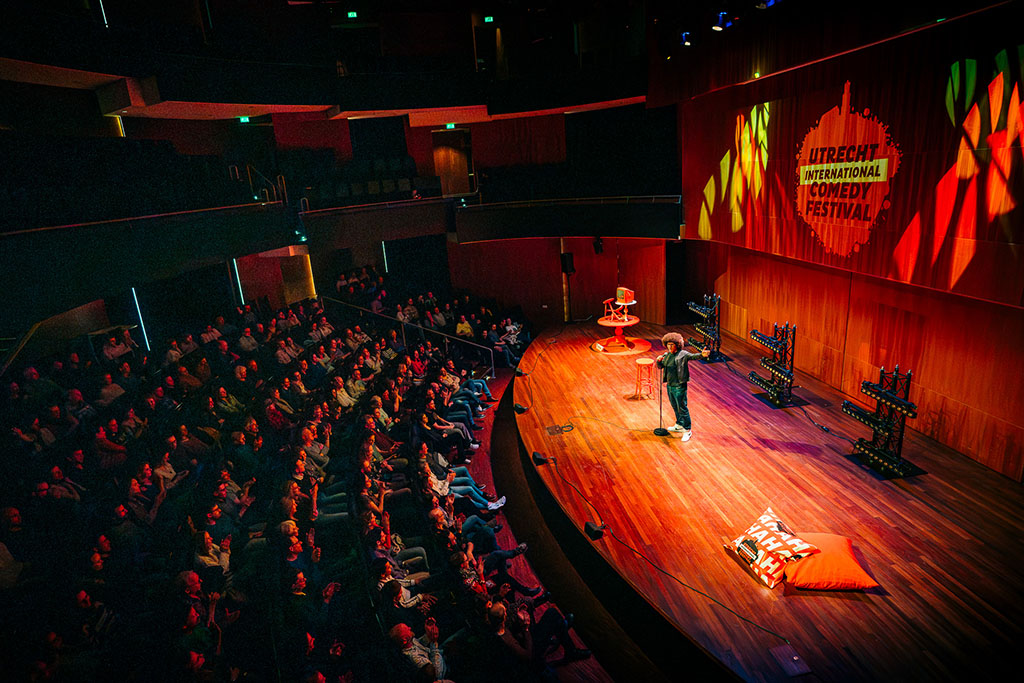
But why has this type of comedy become so popular? According to Utrecht comedian Hans Gommer, the answer is simple: marketing. ‘A lot of comedians promote themselves via social media. The algorithm rewards you for posting a new clip every day. But posting the jokes you’ve come up with means revealing large parts of your show. So it’s better to post interaction with the audience: it’s free promotion using unique moments.’
Power struggle
Roos Vervelde, comedian at the Comedyhuis Utrecht, agrees. ‘Every interaction is different, because the audience is never the same. You give
the audience the feeling that they are witnessing something special.’
Performers can gain credibility with an improvised gag, as long as the vibe in the theatre is good and audience members feel at ease. Roos: ‘Some colleagues think it’s okay to cross the line when interacting with the audience. But audiences are emotionally intelligent. You’ll ruin the atmosphere if the audience notices that a joke about a bald man hasn’t gone down well with the man himself.’
Emma van Puffelen, also from the Comedyhuis, has noticed a power struggle in audience interaction. ‘The person on stage assumes an alpha role: they’re the one who sets the tone and leads the conversation. If a member of the audience calls out, the comedian has to respond. Crowdwork skills are essential, because you can’t risk losing your audience if the interaction flops.’
But, says Roos, you need to be able to poke fun at yourself too. ‘You have to show some vulnerability if you want to generate mutual trust. You can only make fun of someone if you’re brave enough to admit your own shortcomings.’
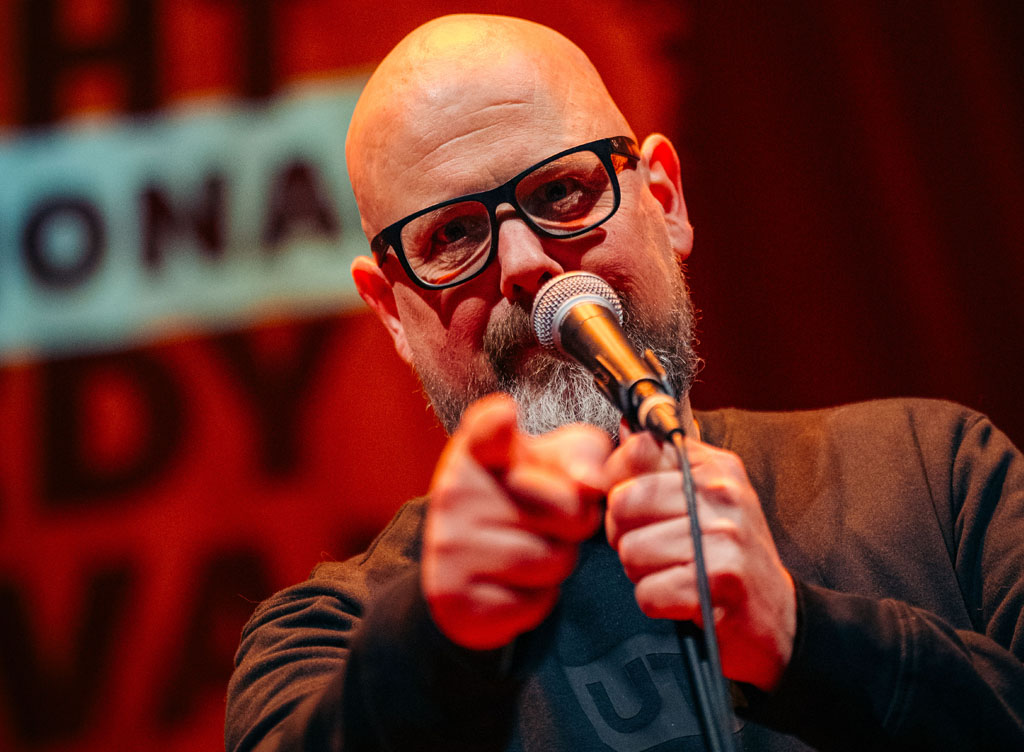
Does that mean that comedy has become less acidic? ‘Not necessarily’, she replies, ‘but there’s more room for comradery on stage, because this is what society craves.’
Quick fix
Although Emma enjoys repartee with the audience, she prefers delivering her own rehearsed gags. ‘To makers, audience interaction is a quick fix of dopamine, a rush. But your own material has more depth: you write it, rewrite it, polish it, write it again, until you get the very most out of it. Audience interaction is more like a snapshot.’
She’s noticed that the former doesn’t always benefit the latter, as it can be tricky to get back into your flow after a quick joke with the audience. It’s something Roos recognises. ‘During interaction, people think: I have to sit up and listen now, something’s going to happen. They’re alert and often laugh more loudly. You can’t always top this with the gags you’ve thought up beforehand.’
Roos also considers her own material to be more interesting. ‘Connecting with the audience is a valuable skill, which can enrich your performance. Compare it with paintings: one is a perfect representation of an object, while another might be more abstract, but much more meaningful in artistic terms. This is how I see easy-going audience interaction versus the deeper layers of my own material.’
Algorithm
Back to the online clips of spontaneous chats with the audience. Do they really help to feed the algorithm? Hans: ‘As a beginner, you need to do everything yourself: promotion, arranging gigs, building a fanbase, and so on. So posting on the socials can be a big help. Posting improvised jokes with the audience is a logical choice as you don’t give away your entire show.’
Roos continues: ‘The Dutch are used to cabaret, not stand-up comedy. Audiences have just started experiencing this genre and it’s becoming very popular, largely thanks to all the clips of audience interaction on Instagram and TikTok.’
25 February to 8 March 2026, various locations
 Lees in het Nederlands
Over dit artikel
text:
Willem Vernooij
images:
UICF in the Kargadoor (header) © Meestermerk; Emma Pot
Publication date:
6 February 2026
Magazine edition:
UITagenda Utrecht februari 2026