The long-deserted, bare basement under Starbucks in Hoog Catharijne has been transformed into the Comedyhuis. ‘We finally have a place where we can experiment and get it wrong.’
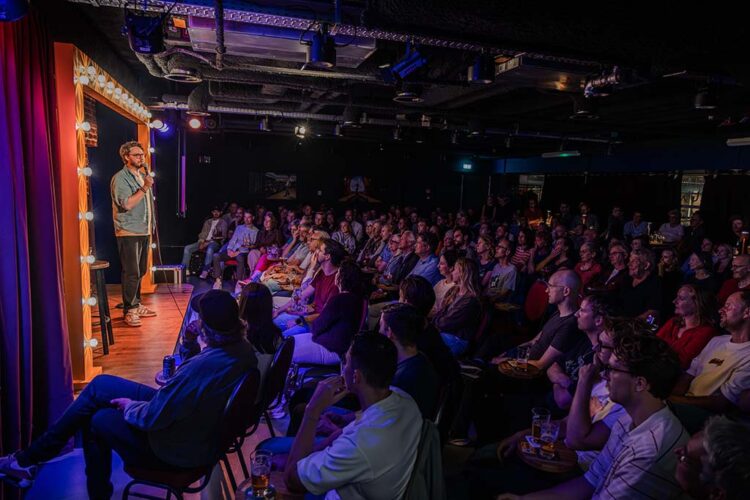
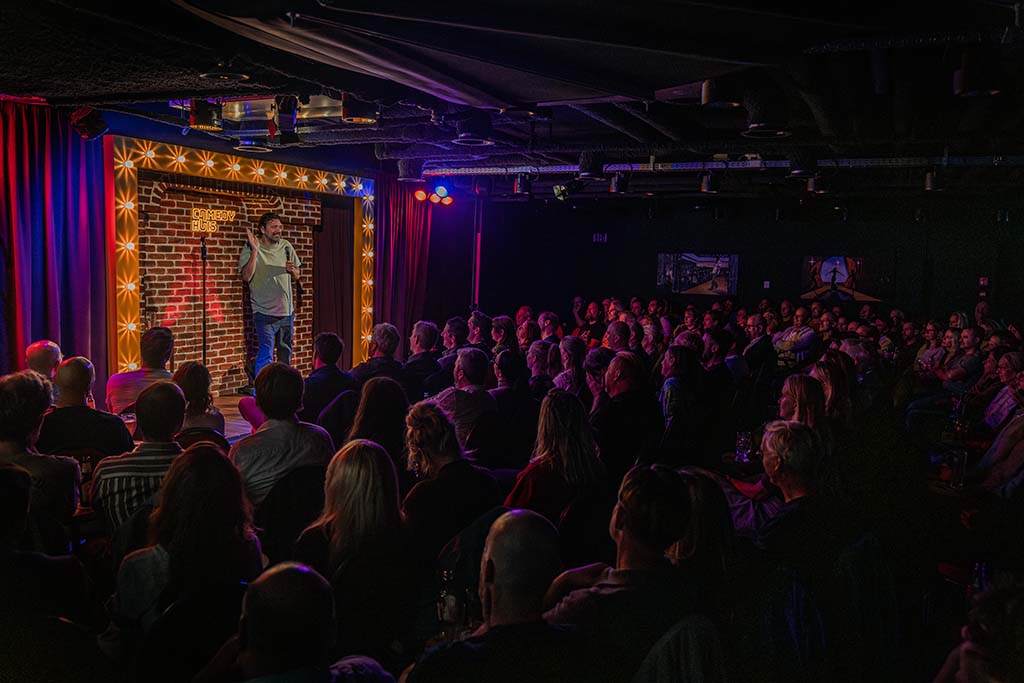
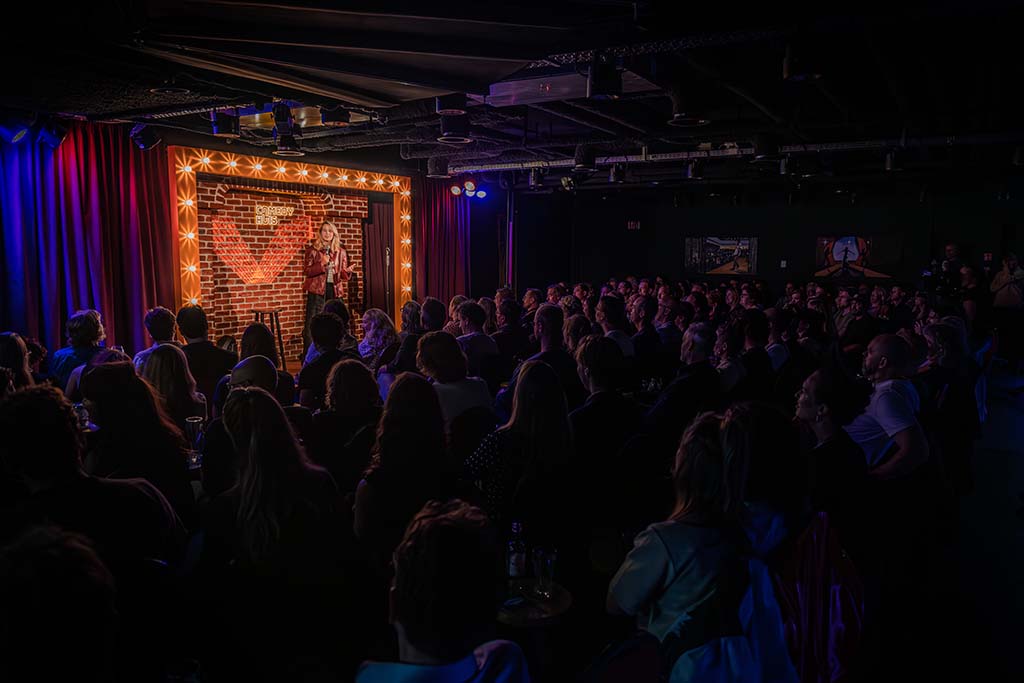
There’s a sign above some steps on Catharijnesingel: ‘This way to our house-warming.’ Without the sign, you probably wouldn’t find the new comedy club under the shopping mall. But once you’re in, you get a great view of the canal, and the odd boat packed with passengers trying to get a glimpse of what’s going on inside. This evening, the large, but cosy club is hosting almost one hundred guests at its house-warming. Every evening for a week, the Comedyhuis is welcoming the people of Utrecht with a wide range of different comedians. ‘We want to introduce ourselves and our regular comedians’, explains Jeroen Pater, artistic director. These resident comedians can invite a favourite colleague to perform with them as a duo.
Torture
Tobi Kooiman opens tonight’s show. You hear him before you can see him, which makes the audience peer around in confusion. Tobi has invited Victor Luis van Es, resident comedian at Club Haug in Rotterdam, to appear alongside him. They discuss everything under the sun: living together, getting pregnant, unbeing faithful. The audience listens intently. The comedians don’t only capture their attention, but before they know it, the audience is part of the show. A couple sitting in the front row seem to be a favourite target. Tobi draws them into a dilemma: would you rather be tortured yourself for fifteen minutes, or let your partner be tortured for ten minutes? The man picks the first option. But then comes the next question: how many minutes would it take for you to change your mind? The dilemma is then put to the audience as a whole.
Rollercoaster
The Comedyhuis was a guest in the Kargadoor on Oudegracht for almost ten years. Jeroen and his colleagues had been looking for their own place for quite some time. ‘If you hire a venue, there’s not really anywhere to hang around after the show. Comedy can be very intense. You need to unload afterwards with your colleagues, talk about what went well and what fell flat. So now we’ve finally got somewhere to do this, he explains.
Jeroen is a comedian as well as artistic director. He knows exactly what it feels like to be on stage. ‘It’s a rollercoaster. Stressful and exciting, but as soon as it’s finished, you can’t wait to do it all over again.’
The Comedyhuis aims to be a place where comedians feel free to try out their weird and wonderful ideas – knowing that they might fail. ‘You always learn something, even from a bad idea. You sometimes have to fall flat on your face to make something great.’ That’s why Sunday is the designated experimental evening.
Posturing
Portraits of the 25 resident comedians adorn the walls, all of them pulling funny faces. There’s a relatively large number of women. Strange, because men still tend to dominate the world of comedy. Eighty percent of the comedians who signed up for the Comedy Talent Award organised by Comedyhuis are male, for example.
Jeroen: ‘We want everyone to have a voice on this podium, so we don’t just listen to white men. It’s much more interesting to hear something you might not have known.’ In his show, for example, Victor talks about a trip to the barber, who asked him if he had a girlfriend. To which he replied that he was engaged to a guy.
Luckily, this diversity is becoming more visible on the Dutch scene, including with regard to standards and values. Jeroen: ‘People used to spend a lot of time posturing, undermining and belittling each other. That was definitely the vibe in the world of comedy when I started out, and it wasn’t very nice.’ This culture seems to be disappearing, but we still have a long way to go. He thinks that the organisers can play a role in this respect. ‘Comedians on stage are pretty vulnerable, and this is something that organisers should be aware of. We try to get both parties round the table regularly to talk about what’s going on.’
Red flags
There’s a show programmed every evening of the week in the new Comedyhuis. The space is used for conferences or events during the day. ‘And if the organisers of these events want a nice way to end the day’, says Jeroen, ‘they can hire one of our comedians!’
At the Kargadoor, the club is still putting on English shows, training comedians and running the ‘Freedom is no joke’ project, in which comedians who have migrated to the Netherlands work with former refugees. Jeroen: ‘This generates some painful, but very funny comedy.’
During this evening’s performance, light-hearted anecdotes are alternated with more serious topics. One minute it’s about homophobia, the next it’s about casual dating and recognising red flags. ‘China wants its flag back,’ Victor jokes about a friend with some very peculiar habits.
Your mother
Since moving to the new location, Jeroen has found it much easier to put his ideas into practice. ‘If I think of something, I can simply say to myself: let’s do this. No sooner said than done. There’s nothing holding us back.’ This freedom means that all the ideas that had to be shelved are suddenly feasible. Like the plan we called ‘Your mother’, for which comedians coach their own mothers. They then go on stage together. He laughs: ‘You can expect that concept here soon, but I think I’ll have to convince my own mother first.’
 Lees in het Nederlands
Over dit artikel
Publication date:
6 November 2026
Magazine edition:
UITagenda Utrecht november 2026